

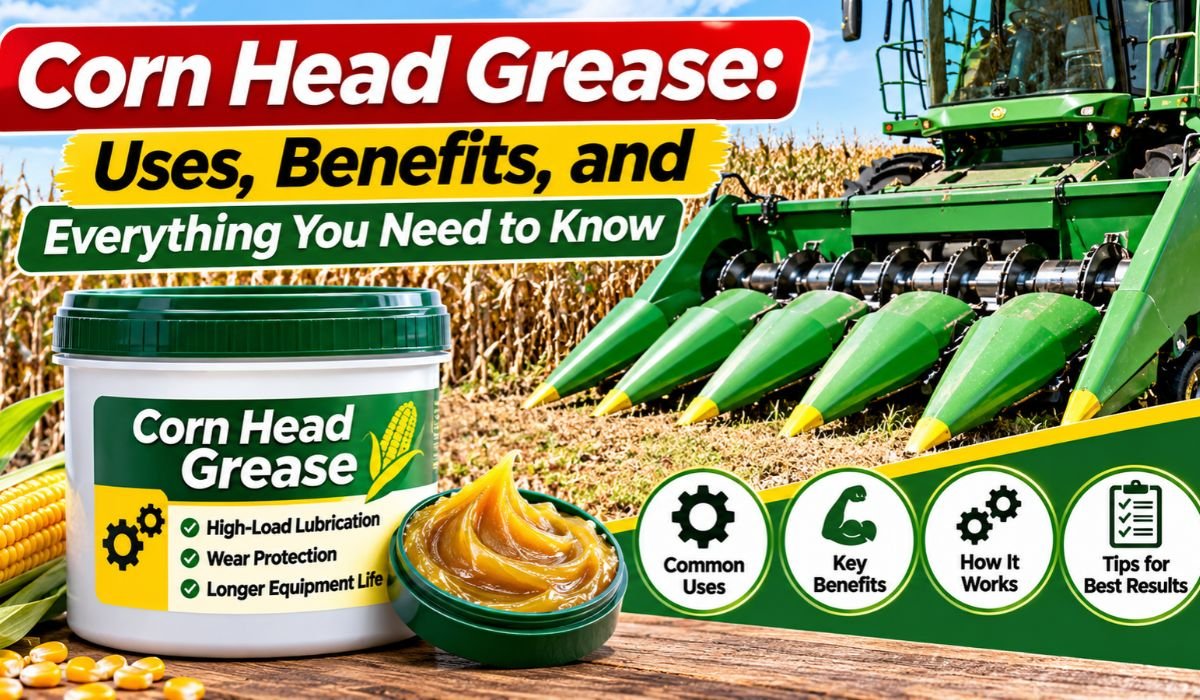
Agricultural machinery works under demanding conditions, especially during harvesting season. Heavy workloads, changing temperatures, dust, and moisture can place considerable stress on moving parts. Proper lubrication is essential for keeping equipment running smoothly and preventing unnecessary mechanical problems. This is where Corn Head Grease becomes particularly useful.
Corn Head Grease is a specialized semi-fluid lubricant designed for certain agricultural gearboxes and industrial applications. Unlike many conventional greases, it combines controlled flow with lubricant retention, helping protect moving components inside suitable enclosed gear cases.
Whether you operate a corn harvester, maintain farm equipment, or work with industrial machinery, understanding how Corn Head Grease works can help you make better maintenance decisions. This guide explains its features, benefits, applications, selection considerations, and proper maintenance practices.
What Is Corn Head Grease?
Corn Head Grease is a semi-fluid lubricant developed primarily for gear cases found in agricultural corn harvesting equipment. Its consistency allows it to move within suitable enclosed gearboxes while remaining more resistant to escaping through small openings than many liquid lubricants.
A corn head is the front attachment of a combine harvester that gathers corn stalks, separates the ears, and feeds harvested material into the machine. Its moving components operate under substantial mechanical loads and require dependable lubrication.
Corn Head Grease is particularly useful in gear cases designed to operate with semi-fluid lubricants. However, not every corn head gearbox requires the same grease. The correct product depends on the equipment manufacturer’s specifications.
Quick Information About Corn Head Grease
| Feature | Information |
|---|---|
| Product Type | Semi-Fluid Lubricating Grease |
| Primary Application | Agricultural Corn Head Gear Cases |
| Industrial Applications | Selected Gearboxes And Bearing Systems |
| Main Purpose | Lubrication And Component Protection |
| Consistency | Typically Semi-Fluid |
| Common Equipment | Corn Harvesters And Agricultural Machinery |
| Base Oil | Mineral Or Synthetic, Depending On Product |
| Thickener System | Varies By Manufacturer |
| Special Formulation | May Include Thixotropic Polymers |
| Lubrication Method | Movement Within Compatible Gear Cases |
| Main Benefit | Lubrication With Controlled Retention |
| Moisture Protection | Depends On Product Formulation |
| Temperature Performance | Product-Specific |
| Leakage Control | May Help Reduce Lubricant Escape |
| Wear Protection | Depends On Lubricant And Operating Conditions |
| Maintenance Requirement | Regular Inspection And Monitoring |
| Compatibility | Must Match Equipment Specifications |
| Common Alternative | Gear Oil, Only Where Approved |
| Product Example | D-A Corn Head Grease |
| Best Selection Method | Follow Manufacturer Recommendations |
How Does Corn Head Grease Work?
Corn Head Grease works by providing a lubricating layer between moving metal surfaces. This layer helps reduce friction and wear while allowing gears and other components to operate efficiently.
Its semi-fluid consistency is especially important. Grease that is too thick may not move adequately through certain gear cases, while lubricant that is too thin may escape more easily through worn seals.
Some Corn Head Grease formulations contain thixotropic materials. These materials can become more fluid when subjected to mechanical movement and recover some of their original consistency when the movement decreases.
This behavior helps the lubricant move during operation while supporting retention when the equipment is stationary. Actual performance depends on the formulation, gearbox design, and operating conditions.
What Is Corn Head Grease Made Of?
Corn Head Grease generally contains base oil, a thickening system, and performance additives. Each component contributes to its lubrication characteristics.
Base oil provides the primary lubricating film that separates moving surfaces. Depending on the product, manufacturers may use refined mineral oils or synthetic base oils.
Thickeners control consistency and help retain the oil within the grease structure. Some specialized products use polymers to achieve particular flow and retention properties.
Performance additives may improve oxidation resistance, corrosion protection, or wear resistance. However, not every product contains the same additive package.
Understanding these differences matters because two products described as Corn Head Grease may not have identical specifications or compatibility.
Key Features Of Corn Head Grease
The most recognizable feature of Corn Head Grease is its semi-fluid consistency. This characteristic makes it suitable for certain enclosed gear cases where controlled lubricant movement is required.
Another important feature is its ability to remain within a compatible housing while providing lubrication to moving components. This can be useful in equipment where lubricant leakage is a concern.
Some formulations also provide resistance to moisture, oxidation, and mechanical stress. These properties are particularly valuable in agricultural environments where machinery encounters dust, humidity, and changing weather conditions.
Certain products are marketed for all-season use. However, operators should always check the manufacturer’s temperature recommendations rather than assuming every grease performs equally well in extreme conditions.
Main Uses Of Corn Head Grease
Corn Head Grease is most closely associated with agricultural corn harvesting equipment. Compatible corn head gear cases use specialized lubrication to protect gears, shafts, and related moving components.
During harvesting, corn heads operate for extended periods and experience repeated mechanical loads. Suitable lubrication helps these assemblies function reliably throughout demanding fieldwork.
Beyond agriculture, some semi-fluid grease formulations are suitable for industrial gearboxes and selected bearing applications.
For example, D-A Corn Head Grease is described as suitable for certain leaking cutter head gear cases on continuous miners. These machines operate in demanding mining environments where lubrication and lubricant retention are important.
Such industrial applications require careful attention to equipment specifications because lubricant requirements can differ considerably.
Benefits Of Using Corn Head Grease
One major benefit of Corn Head Grease is its ability to provide lubrication while helping control lubricant movement within compatible equipment.
By maintaining a lubricating film between moving components, the correct grease can reduce friction and limit lubrication-related wear.
Its semi-fluid consistency may also help reduce lubricant escape compared with gear oil in certain applications. However, grease cannot permanently repair damaged seals, cracked housings, or severely worn components.
Proper lubrication can support dependable machinery operation and reduce avoidable maintenance interruptions.
Another advantage is its suitability for specialized equipment. Instead of relying on a general-purpose grease, operators can select a lubricant formulated for the flow and retention requirements of their gear cases.
Corn Head Grease Vs Regular Grease
Corn Head Grease and regular grease differ mainly in consistency, intended applications, and formulation.
Many conventional greases are relatively thick and designed to remain near bearings, joints, or other lubrication points. Corn Head Grease is typically softer, allowing it to move more readily within suitable enclosed gear cases.
This difference matters because certain gearboxes rely on lubricant movement to reach gears and bearings.
Using grease that is too stiff may prevent adequate lubrication, while an unsuitable fluid lubricant may leak excessively.
Regular grease is not automatically inferior. It simply serves different lubrication requirements. The best choice is always the lubricant specified for the equipment.
Corn Head Grease Vs Gear Oil
Gear oil and Corn Head Grease both protect moving components, but they behave differently inside machinery.
Gear oil flows freely and is commonly used in gearboxes designed for oil circulation, splash lubrication, or other oil-based lubrication methods.
Corn Head Grease has a thicker, semi-fluid structure that can offer improved retention in certain housings.
However, replacing gear oil with grease without manufacturer approval can create serious lubrication problems. A gearbox designed for oil may not distribute grease correctly.
Likewise, replacing specified semi-fluid grease with ordinary gear oil may cause leakage or inadequate lubricant retention.
Neither option is universally better. Proper equipment compatibility is more important than lubricant thickness alone.
How To Choose The Right Corn Head Grease
Choosing Corn Head Grease begins with checking the equipment manual. Manufacturers may specify a particular product, consistency grade, lubricant specification, or approved equivalent.
Grease consistency is commonly classified using the National Lubricating Grease Institute, or NLGI, grading system. Lower grades generally represent softer greases, but the correct grade must be verified for the intended application.
Operating temperature is another important consideration. A lubricant must remain suitable during cold starts and extended operation under demanding conditions.
Moisture exposure, mechanical loading, and gearbox condition also influence selection.
Before purchasing, review the product’s technical data sheet and confirm compatibility with the existing lubricant. Similar appearance does not guarantee that two greases can safely be mixed.
How To Apply Corn Head Grease Correctly
Proper application is essential for effective lubrication. Begin by identifying the correct lubrication point and following the equipment manufacturer’s service instructions.
Before adding grease, clean the surrounding area to prevent dirt and moisture from entering the housing.
Use the recommended dispensing equipment and add only the specified quantity. Some gear cases have dedicated filling points or level-checking procedures.
Avoid assuming that filling the entire gearbox provides better protection. Excess lubricant can cause churning, pressure buildup, leakage, or overheating in certain designs.
After servicing, inspect the housing for visible damage and monitor equipment operation for unusual sounds, temperatures, or leakage.
How Much Corn Head Grease Does A Gearbox Need?
The required quantity of Corn Head Grease varies according to gearbox size, internal design, and manufacturer specifications.
A small agricultural gear case may require a different filling procedure from a larger industrial gearbox.
Adding too little lubricant can leave moving components inadequately protected. Adding too much may create excessive resistance or unwanted internal pressure.
For this reason, operators should use the exact fill quantity or level specified in the service manual.
When a gearbox has experienced substantial leakage, simply adding more grease may not solve the underlying problem. The housing, seals, and internal components should also be inspected.
Common Corn Head Grease Problems And Solutions
Although Corn Head Grease is designed for demanding applications, lubrication problems can still occur.
Grease leakage may result from worn seals, damaged housings, excessive filling, or unsuitable lubricant consistency.
Overheating can indicate lubrication problems, excessive mechanical loading, bearing damage, or internal component wear.
Contamination is another concern. Water, dust, and metal particles can reduce lubricant effectiveness and contribute to mechanical damage.
Mixing incompatible greases may also change consistency or interfere with lubrication performance.
The safest approach is to identify the actual cause of a problem rather than repeatedly adding lubricant. Persistent overheating, noise, or leakage should be investigated before equipment returns to demanding service.
Corn Head Grease Maintenance Tips For Longer Equipment Life
Routine maintenance helps Corn Head Grease perform as intended.
Inspect gear cases regularly for visible leaks, damaged seals, unusual noises, and signs of overheating. These observations can reveal developing problems before they become more serious.
Keep lubrication points clean and use properly maintained dispensing equipment to prevent contamination.
Follow manufacturer-recommended inspection and replacement intervals, particularly during intensive harvesting periods.
Storage also matters. Grease containers should remain sealed, clearly labeled, and protected from contamination and inappropriate temperatures.
Maintaining accurate service records can help equipment owners identify recurring lubrication problems and improve future maintenance decisions.
D-A Corn Head Grease: Features And Applications
D-A Corn Head Grease is a premium-quality multipurpose semi-fluid lubricant designed for equipment where leakage and moisture are concerns.
According to the supplied product description, it uses highly refined base oils and a specialized thixotropic polymer to help maintain a working seal in certain gearbox and bearing applications.
The manufacturer describes it as particularly suitable for all-season lubrication of agricultural corn head gear cases.
It is also intended for certain leaking cutter head gear cases on continuous mining equipment.
These applications demonstrate how specialized semi-fluid grease can serve both agricultural and industrial machinery.
However, the product description alone does not establish its exact NLGI grade, temperature range, or compatibility with every gearbox. Those details should be confirmed through current manufacturer specifications.
Common Mistakes To Avoid When Using Corn Head Grease
One common mistake is assuming that every semi-fluid grease is interchangeable. Products may differ in thickener chemistry, base oil viscosity, additives, and operating characteristics.
Another mistake is using Corn Head Grease in equipment that specifically requires gear oil or a different lubricant.
Overfilling is also a concern because excessive grease may interfere with normal gearbox operation.
Ignoring worn seals or damaged components can create additional problems. Although suitable grease may help control leakage, it should not replace necessary mechanical repairs.
Finally, mixing different products without checking compatibility can reduce lubrication reliability.
Careful product selection and correct maintenance procedures help avoid these mistakes.
When Should You Replace Corn Head Grease?
Corn Head Grease does not have one universal replacement interval. Service requirements depend on equipment design, operating conditions, contamination exposure, and manufacturer recommendations.
Some machinery requires periodic inspection and replenishment, while other applications may have different service procedures.
Visible contamination, unusual lubricant condition, persistent overheating, or evidence of internal wear may indicate that further inspection is necessary.
If water or metal particles enter the gearbox, the lubricant and internal components may require attention.
Following the equipment maintenance schedule is more reliable than choosing an arbitrary replacement period.
Where To Buy Corn Head Grease And What To Look For
Corn Head Grease is commonly available through agricultural equipment dealers, farm maintenance suppliers, and industrial lubricant distributors.
Before buying, confirm that the product meets the machinery manufacturer’s requirements.
Check the lubricant specification, consistency, packaging size, storage condition, and supplier reliability.
A lower purchase price does not necessarily represent better value if the lubricant is unsuitable for the equipment.
Choosing a compatible product from a reputable supplier can help reduce lubrication-related maintenance risks.
Final Thoughts
Corn Head Grease plays an important role in protecting compatible agricultural and industrial machinery. Its semi-fluid consistency helps balance lubricant movement and retention, making it particularly useful in certain enclosed gear cases.
Understanding its formulation, applications, and maintenance requirements can help equipment owners avoid common lubrication mistakes and make more informed purchasing decisions.
Products such as D-A Corn Head Grease demonstrate how specialized lubricants address the demands of agricultural harvesting equipment and selected industrial applications.
Ultimately, the most important factor is not choosing the thickest or most expensive grease. It is choosing a lubricant that matches the equipment’s design and operating requirements.
With correct selection, proper application, and regular maintenance, Corn Head Grease can support reliable equipment operation and help protect valuable machinery over time.
FAQs About Corn Head Grease
What Is Corn Head Grease Used For?
Corn Head Grease is primarily used to lubricate compatible agricultural corn head gear cases. Certain formulations are also suitable for selected industrial gearboxes and bearing applications. Its semi-fluid consistency allows it to move within suitable enclosed housings while helping retain lubricant.
Is Corn Head Grease The Same As Regular Grease?
No. Corn Head Grease is generally softer than many conventional greases and is intended for specific gear case applications. Regular grease may be designed for bearings, joints, or other components. The correct lubricant depends on the equipment’s requirements.
Can Corn Head Grease Stop A Leaking Gearbox?
Corn Head Grease may help reduce lubricant leakage in some compatible gearboxes, particularly compared with thinner lubricants. However, it cannot permanently repair worn seals, cracks, or damaged components. Mechanical problems should be inspected and repaired.
Is Corn Head Grease Waterproof?
Not necessarily. Some formulations provide useful water resistance, but performance varies between products. Water resistance should be verified through manufacturer specifications, and contaminated gearboxes should be inspected rather than assuming the grease provides complete protection.
What NLGI Grade Is Corn Head Grease?
Corn Head Grease is commonly associated with softer, semi-fluid consistency grades, but there is no single grade that applies to every product. The correct NLGI grade should be confirmed through the lubricant’s technical data sheet and equipment manual.
Can Corn Head Grease Be Used In Bearings?
Some formulations are suitable for specific bearing applications. However, not all bearings are designed to operate with semi-fluid grease. Bearing speed, load, sealing arrangement, and manufacturer recommendations determine whether the lubricant is appropriate.
Can You Mix Corn Head Grease With Regular Grease?
Mixing different greases is not recommended without verifying compatibility. Differences in thickeners, base oils, and additives can change consistency and lubrication performance. When changing products, follow the equipment and lubricant manufacturers’ recommended procedures.
How Often Should Corn Head Grease Be Changed?
Replacement intervals vary by equipment and operating conditions. Some gear cases require periodic inspection or replenishment rather than a universal grease-change schedule. Always follow the service manual and investigate contamination, leakage, or abnormal operating conditions.
Learn more and explore exciting content on: Jake Lang Biography: Age, Early Life, Political Career, and Controversies
[…] Learn more and explore exciting content on: Corn Head Grease: Uses, Benefits, and Everything You Need to Know […]